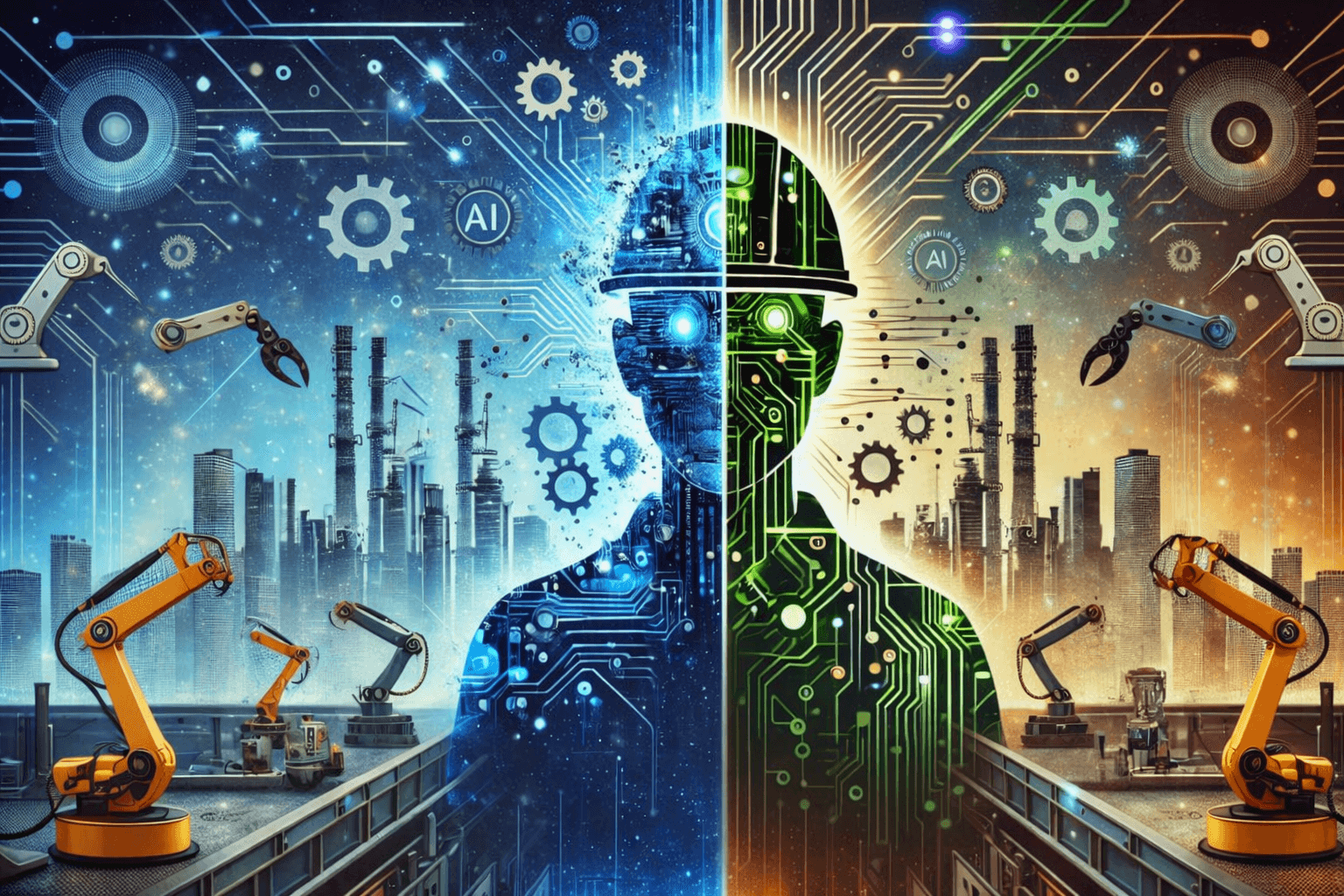
January 2026 marked a pivotal turning point in the development of artificial intelligence. AI is evolving from an “interactive tool” into a “physical entity” capable of fundamentally transforming all industrial sectors—especially manufacturing.
Physical AI and the Robotics Era
Jensen Huang, CEO of NVIDIA, announced at CES 2026 that “the ChatGPT moment for robotics has arrived,” signaling a mass transition of AI from the virtual space into the physical world. NVIDIA introduced a series of open models for physical AI, including the Cosmos models capable of understanding the world and generating action plans, as well as Isaac GR00T N1.6, dedicated to humanoid robots.
The new Jetson T4000 module, based on the Blackwell architecture, delivers four times higher energy efficiency and AI compute performance compared to the previous generation, priced at USD 1,999 (for orders of 1,000 units). Global companies such as Boston Dynamics, Caterpillar, Franka Robotics, LG Electronics, and NEURA Robotics presented a new generation of robots powered by NVIDIA technologies.
Competition Among Large Language Models
The DeepSeek Breakthrough
On January 9, Chinese startup DeepSeek announced plans to release its V4 model in mid-February 2026. The model specializes in coding capabilities and, according to internal tests, outperforms Anthropic’s Claude and OpenAI’s GPT series. DeepSeek achieved a breakthrough in handling extremely long code prompts and introduced a new AI training method called Engram, demonstrating how large models can be trained on less powerful chips.
OpenAI and Google Initiatives
OpenAI announced five new data center locations as part of the USD 500 billion Stargate project, developed in partnership with Oracle and SoftBank. The project involves massive investments in AI infrastructure over the next four years.
On January 14, Google introduced the Personal Intelligence feature in the Gemini app, which tailors AI assistant responses based on a user’s photos and emails. Gemini’s integration with Gmail enables summarization of long email threads and instant answers to questions in natural language.
The AI Infrastructure Challenge
A global shortage of HBM (high-bandwidth memory) has caused prices to more than double since February 2025. SK Hynix and Samsung have already sold out their entire production capacity for 2026 and have begun taking reservations for 2027. The Stargate project alone will require 900,000 wafers per month by 2029—approximately twice the current global HBM production.
Five Key Trends in Manufacturing
Autonomous Production Planning
IDC predicts that by 2026, over 40% of manufacturers with production planning systems will upgrade them with AI-based capabilities and begin incorporating autonomous processes. Agentic AI can make integrated decisions optimizing demand forecasting, inventory management, and equipment utilization, dynamically adjusting production plans in real time.
Digital Twins and Simulation
NVIDIA’s Cosmos model enables physics-based synthetic data generation and evaluation of robotic policies. Manufacturers can build digital twins of production lines and simulate various scenarios before deploying real equipment. The Isaac Lab-Arena framework allows full validation in a simulated environment prior to introducing robots into production facilities.
AI-Integrated Workforce Training
The U.S. will need 3.8 million new manufacturing workers by 2033, yet up to 1.9 million positions may remain unfilled due to the skills gap. AI-driven training programs can shorten learning curves for new employees and embed the expertise of experienced technicians into AI systems. GE Aerospace will invest USD 30 million over the next five years to train 10,000 highly skilled workers starting in 2026.
Smart Factories
According to Deloitte, most manufacturers plan to allocate at least 20% of their improvement budgets to smart manufacturing initiatives, including automation hardware, data analytics, sensors, and cloud computing. By 2029, an estimated 30% of factories will use open, virtualized, software-defined automation platforms for centralized control system management.
Predictive Supply Chain Optimization
Agentic AI could generate up to USD 650 billion in additional revenue per industry by 2030 and automate repetitive tasks, reducing costs by up to 50%, according to McKinsey research. In manufacturing, the technology will be applied to raw material procurement, inventory optimization, and logistics management.
Challenges and Outlook
By 2029, 75% of large manufacturers will use AI-supported OT (operational technology) cybersecurity safeguards to mitigate data model contamination risks. By 2027, 40% of all operational data will be autonomously integrated across applications and platforms by AI agents.
Companies that fail to design bidirectional skill-transfer loops between humans and robots by 2028 are projected to incur 20% higher downtime and training costs, along with lower efficiency, compared to competitors. Creating a cyclical learning system—where robots not only learn from humans but also feed accumulated data and experience back into human training—will be critical.
The year 2026 marks the transition of AI in manufacturing from an “experimental phase” to a “deployment phase.” Positioning AI not as a “replacement for humans,” but as a “human amplifier,” and establishing an optimal collaboration between technology and people will be the key to sustainable growth in the manufacturing industry.