Introduction
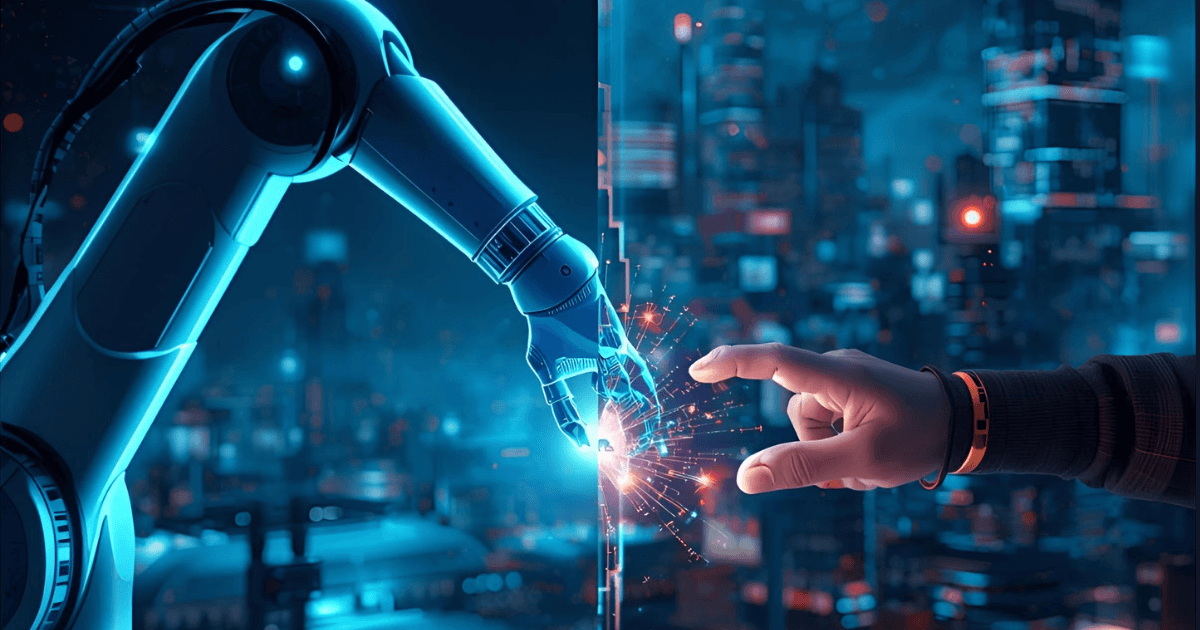
For more than a decade, industrial digitalization has set new directions in manufacturing. The term Industry 4.0 became a symbol of the Fourth Industrial Revolution – the era of automation, robotics, and the Internet of Things (IoT). Today, Industry 5.0 is gaining traction. It does not replace 4.0 but builds on it, adding a new dimension: the integration of humans and technology in a sustainable and responsible way.
Where do the numbers come from?
The numbering of “industrial revolutions” is conventional and helps to organize the historical development of technology:
-
Industry 1.0 (late 18th century): mechanization, steam and water power.
-
Industry 2.0 (19th/20th century): electricity, assembly lines, mass production.
-
Industry 3.0 (1970s): process automation, first IT systems, industrial robots.
-
Industry 4.0 (from ~2011): digitalization, IoT, Big Data, artificial intelligence, smart manufacturing.
-
Industry 5.0 (from ~2020): human-machine collaboration, mass personalization, sustainability, AI ethics.
Each stage does not negate the previous one but expands on it, responding to new economic and social needs.
Key features of Industry 4.0
-
Automation and robotics: machines take over an increasing range of tasks.
-
Internet of Things (IoT): devices communicate with each other and with management systems.
-
Big Data and predictive analytics: sensor data helps predict failures and optimize production.
-
System integration: from the shop floor to ERP and MES systems, everything is digitally connected.
-
Smart Factory: the factory becomes an autonomous organism capable of independent, data-driven decisions.
Business impact: cost reduction, higher efficiency, faster market response.
Key features of Industry 5.0
-
Human-centric: people return to the center of the process – technologies support decisions rather than replace them.
-
Mass personalization: a shift from mass production to customized manufacturing (e.g., personalized medicine, on-demand production).
-
AI and cobots: intelligent machines work alongside humans, adapting to their needs.
-
Sustainability: focus on ecology, circular economy, and reducing carbon footprint.
-
AI ethics and responsibility: implementing AI with respect for privacy, human rights, and safety.
Business impact: building competitive advantage through user- and eco-friendly innovation, not just cost optimization.
Practical differences – 4.0 vs 5.0
| Aspect | Industry 4.0 | Industry 5.0 |
|---|---|---|
| Goal | Efficiency and automation | Human-machine collaboration |
| Core technology | IoT, AI, Big Data, automation | Cobots, ethical AI, personalization |
| Human role | System supervisor, limited role | Process partner, creator |
| Production model | Mass production, cost-driven | Customized, sustainable production |
| Business value | Lower costs, faster processes | New business models, customer loyalty, ESG |
Impact on modern factory digitalization
-
Integration with MES/ERP systems: increasing importance of platforms connecting production and business data (e.g., OmniMES, SAP, Siemens Opcenter).
-
New business models: subscriptions, on-demand production, digital twins.
-
Employee competencies: engineers must combine IT skills with human factors such as ergonomics, safety, and AI collaboration.
-
ESG investments: digitalization also supports environmental reporting and EU compliance (e.g., Fit for 55).
Conclusion
Industry 4.0 and 5.0 are not competing concepts but stages of the same digital revolution. 4.0 focuses on automation and data, while 5.0 emphasizes human-technology collaboration and sustainability. This means that factories are not only becoming smart but also responsible and adaptable.
For business, the difference is fundamental: from a “cost factory” to a “value factory” – where customers, employees, and the environment benefit alongside the enterprise.
Next steps in digitalization
Companies aiming to implement Industry 4.0 and 5.0 concepts need systems that not only collect data but also support decision-making and ensure full process integration.
One such solution is OmniMES – a proprietary MES-class system that combines production digitalization with modern Industry 5.0 trends. More information can be found here: www.omnimes.com