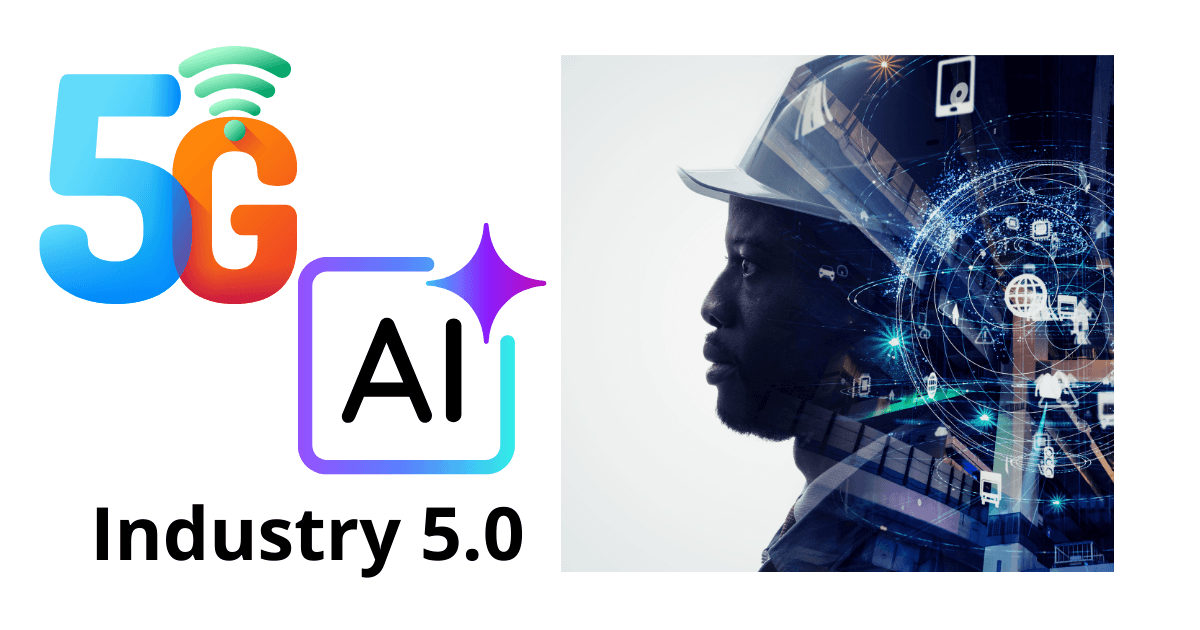
Introduction to the Era of Industry 5.0
Industry is on the brink of a new revolution. Industry 5.0 marks an era of human–machine collaboration that prioritizes sustainability, where AI is not merely a tool but a strategic enabler of transformation. Unlike Industry 4.0, which focused on automation and digitalization, Industry 5.0 emphasizes human–machine collaboration, sustainable development, and the integration of ESG (Environmental, Social, Governance) principles with advanced technologies.
The key difference: Industry 5.0 does not replace humans with machines but creates intelligent systems where AI acts as a strategic partner, supporting workers in making better real-time decisions.
Financial Justification for Industry 5.0 Investments
Impressive ROI Indicators in 2025
Recent market research shows that Industry 5.0 solutions deliver spectacular financial returns:
-
87% of industrial enterprises with private 5G see ROI within 12 months
-
Companies leveraging BPO automation achieve 240% ROI within months
-
Organizations implementing generative AI realize an average ROI of 1 invested, with top performers achieving up to $10.3
Dynamic Market Growth
-
McKinsey predicts global IIoT spending will grow from 500 billion in 2025 – a staggering 72% increase in just one year.
-
Gartner forecasts that by 2025, 25% of industrial companies will acquire or invest in an IIoT platform, signaling rapid adoption of Industry 5.0 technologies.
Technologies Driving the Transformation of Monitoring
AI-Powered Predictive Maintenance
Predictive maintenance is a fundamental pillar of Industry 5.0. According to the AI-Based Predictive Maintenance Market Report 2025–2030, the market is projected at US$1.69 billion.
Key benefits include:
-
30–50% reduction in unplanned downtime
-
Up to 40% savings in maintenance costs
-
20–30% extension of equipment lifespan
-
Optimized spare parts inventory
Private 5G Networks as the Backbone of Connectivity
“Private 5G has been a game changer for BASF Antwerp. We’re unlocking automation, strengthening occupational safety, accelerating innovation, and meeting ROI targets in just two years,” confirms Steven Werbrouck, BASF connectivity expert.
Advantages:
-
Ultra-low latency (<1ms) for critical applications
-
99.99% reliability
-
Enterprise-grade security
-
Scalability to thousands of IoT devices
Edge Computing and Distributed Processing
Edge computing enables real-time data analysis close to the source, reducing reliance on cloud infrastructure and ensuring resilience. Benefits include:
-
Real-time processing without network delays
-
Lower data transmission costs
-
Autonomous machine decision-making
-
Increased system resilience
Real-World Use Cases and Savings
-
Case 1: BASF Antwerp – Comprehensive Digitalization
Private 5G deployment across a 6 km² site delivered ROI in 2 years, process automation, improved safety, and real-time monitoring. -
Case 2: Energy Savings
89% of organizations report significant energy savings through predictive maintenance, connected IoT devices, drones monitoring emissions, and precise energy tracking. -
Case 3: Reduced Operating Costs
-
50% reduction in agency scope (saving $5M over 3 years)
-
Legacy system consolidation freed up one FTE and saved $492,400
-
Key Technologies for Industry 5.0
-
Digital Twins – simulation, workflow optimization, predictive modeling
-
Industrial IoT & Smart Sensors – real-time monitoring of temperature, vibration, energy use, and product quality
-
AR/VR with AI – remote support, immersive training, real-time visualization
Implementation Challenges and Solutions
-
Measuring ROI – 49% struggle; solution: clear KPIs, benchmarking, real-time monitoring
-
Talent Shortage – 2.1M unfilled jobs by 2030; solution: reskilling, automation, AI upskilling
-
Security & Governance – Zero Trust Architecture, encryption, audits, compliance
Trends and Outlook for 2025+
-
Agentic AI – autonomous AI agents managing processes in real-time
-
Sustainability Priority – decarbonization as the new “space race”
-
Human–Machine Collaboration – augmenting human skills, reducing risk, enhancing precision
Roadmap for Industry 5.0 Implementation
-
Phase 1 (2–3 months): Assessment and planning
-
Phase 2 (6–9 months): Pilot project with IoT + AI predictive analysis
-
Phase 3 (12–18 months): Scaling across production lines, ERP/MES integration
-
Phase 4 (18+ months): Organizational transformation with digital twins & agentic AI
Best Practices for Maximizing ROI
-
Start small and scale successful pilots
-
Integrate with existing IT/OT infrastructure
-
Focus on high-value use cases
-
Invest in AI and IoT talent
-
Continuously monitor and optimize KPIs
Conclusion: The Future Has Already Begun
Industry 5.0 is not a distant vision but a present reality. Organizations investing today in intelligent monitoring, AI, and advanced connectivity achieve ROI of 240% within months.
Key takeaway: The Fifth Industrial Revolution will reward companies that act now. Those delaying adoption risk losing their competitive edge.
Bottom line: Investment in Industry 5.0 is not a cost but a strategic necessity. With the right approach, ROI exceeding 200% in the first year is achievable.
Based on 2025 market research from McKinsey, Gartner, IBM Institute for Business Value, Nokia Industrial Digitalization Report, and leading industry case studies.