Introduction
Industry 5.0 is no longer just about automation but about smart use of data. With IoT and MES, every machine produces endless streams of signals. The challenge is not in collecting them, but in analyzing and using them in real time. Vector databases and AI are increasingly at the heart of this process.
Why are time series difficult?
Factories generate:
-
sensor data (vibration, temperature, pressure),
-
event logs (failures, alarms, downtime),
-
process sequences (cycle times, parameter changes).
Traditional databases are not optimized for detecting hidden patterns or anomalies.
How vector databases work
Instead of storing data as rows, a vector database (FAISS, Qdrant, Milvus) represents them as numeric vectors in a multidimensional space. This enables:
-
similarity search across signals,
-
contextual retrieval instead of exact matching,
-
faster and more scalable analysis.
New use case: turning factory data into knowledge
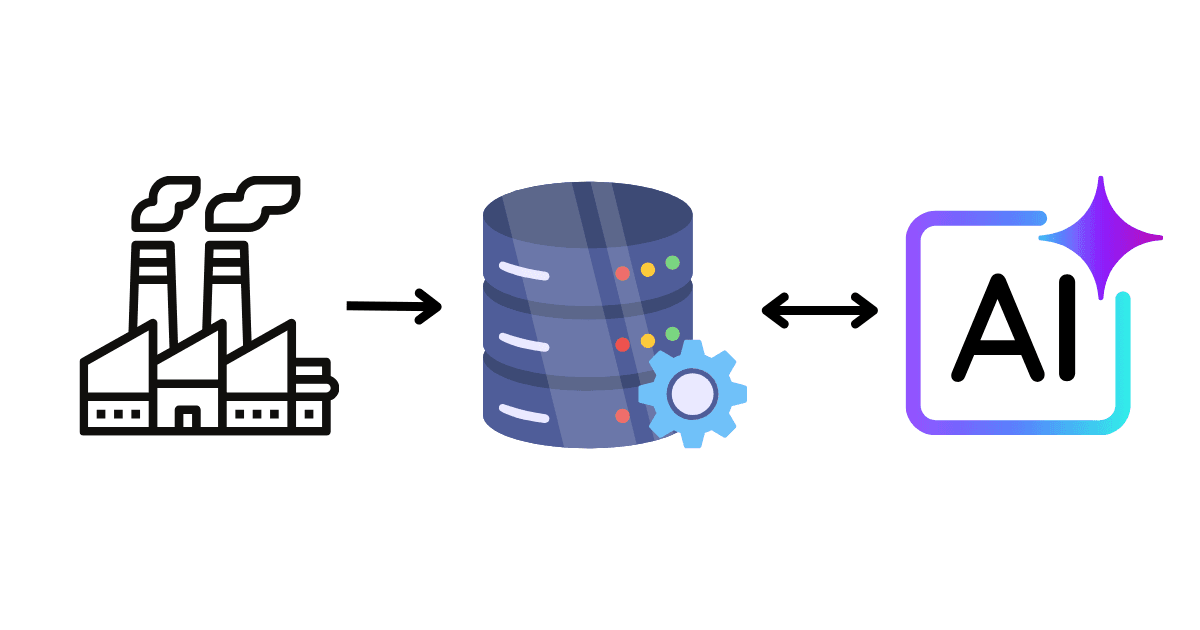
Sensor streams are translated into vectors and stored directly in a vector database. From there they can be:
-
queried by LLMs in natural language (e.g., “When was the last downtime of line 3?”),
-
used for real-time alerts and automated reports,
-
integrated with knowledge graphs of the entire factory.
This goes beyond predictive maintenance. It is a knowledge interface for engineers, enabling them to ask simple questions and receive instant, context-aware answers.
Facts and evidence
-
McKinsey (2023) reports that manufacturers using vectorized data pipelines reduced reporting times by up to 60%.
-
Automotive industry pilots show engineers retrieving historical downtime data in seconds using LLM queries instead of manually searching through logs.
-
Platforms like Siemens MindSphere and GE Predix already experiment with vector-based data services.
Conclusion
Vector databases are not only tools for prediction, but also for making industrial knowledge accessible. Combined with LLMs, they allow anyone on the shop floor to query time series data as easily as asking a question in plain language. This marks a fundamental shift in how Industry 5.0 systems deliver value.