The date has come and gone. Under the recast Energy Efficiency Directive, firms using more than 10 TJ of energy a year on average were due their first energy audit by 11 October 2026. In Poland, the law that would pass that duty on to companies does not exist yet. Bill UC77 has not cleared the Council of Ministers, and the Sejm, the Senate and the president's signature all still lie ahead.
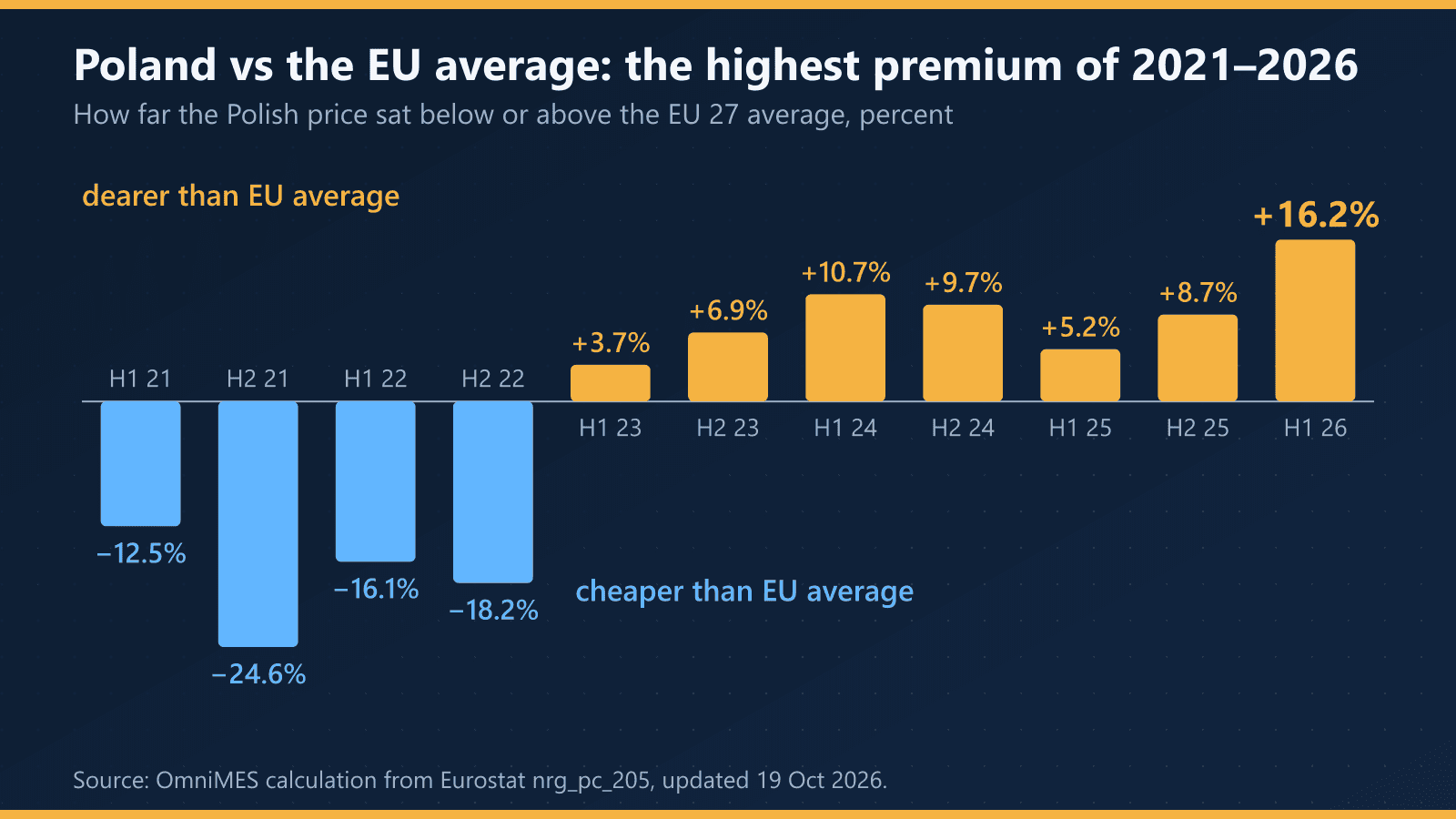
That leaves a plant above the threshold with two separate problems. The legal one is still open. The financial one is already here: Eurostat data published on 19 October show Polish mid-sized industrial buyers paid 16.2% more for electricity than the EU average in the first half of 2026, the highest premium in the 2021–2026 period.
Poland is the example here, but the pattern is wider: only Czechia had reported full transposition on time. If you run a plant anywhere in the EU, the useful questions are the same. What binds you today, what is coming, and what is worth doing before the national text lands.
What binds a plant today
Two layers of law need separating.
Directive (EU) 2023/1791, Article 11, tells Member States to make sure that enterprises averaging more than 85 TJ a year over the previous three years, across all energy carriers, implement an energy management system. Enterprises above 10 TJ without such a system must go through an energy audit at least every four years. Commission Recommendation (EU) 2024/2002 sets out the calendar: Article 11 was to be transposed by 11 October 2025, the rules on the first audit for newly covered firms by 11 October 2026, and those on the first management systems by 11 October 2027.
Poland's Energy Efficiency Act (consolidated text, Journal of Laws 2025, item 711) still uses the old test, company size. Under Article 36, an entrepreneur other than a micro, small or medium-sized one carries out an audit every four years. A firm with an energy management system or EMAS that includes an audit is exempt. If the audit is missing, the President of the Energy Regulatory Office can impose a fine of up to 5% of the previous tax year's revenue (Articles 39 and 40).
So a large Polish company has had this duty for years, and nothing has paused it. A mid-sized one above 10 TJ will not find it in the current Act until the amendment takes effect. That is our reading of the texts rather than legal advice, so confirm it with counsel before relying on it.
The delay is not a Polish speciality:
| Date | Event |
|---|---|
| 30 September 2025 | Bill UC77 published |
| 11 October 2025 | General transposition deadline expires |
| 21 November 2025 | Commission sends letters of formal notice to 26 Member States, Poland included. Only Czechia had reported full transposition |
| 4 June 2026 | Reasoned opinions for Hungary and Romania |
| October 2026 | Reasoned opinions for Greece, Spain, Italy and Malta |
| 11 October 2026 | EU date for the first audit of newly covered firms |
| 11 October 2027 | EU date for the first energy management systems |
Poland is not among the countries named for this directive in the June and October packages. The matter is not closed, though. States that leave transposition unfinished can expect a reasoned opinion, and after that a possible referral to the Court of Justice.
What bill UC77 changes
The main change is the test itself: energy use replaces company size. Sławomir Różycki of Efetech described the post-consultation draft in WysokieNapiecie.pl on 23 October. It sets three levels.
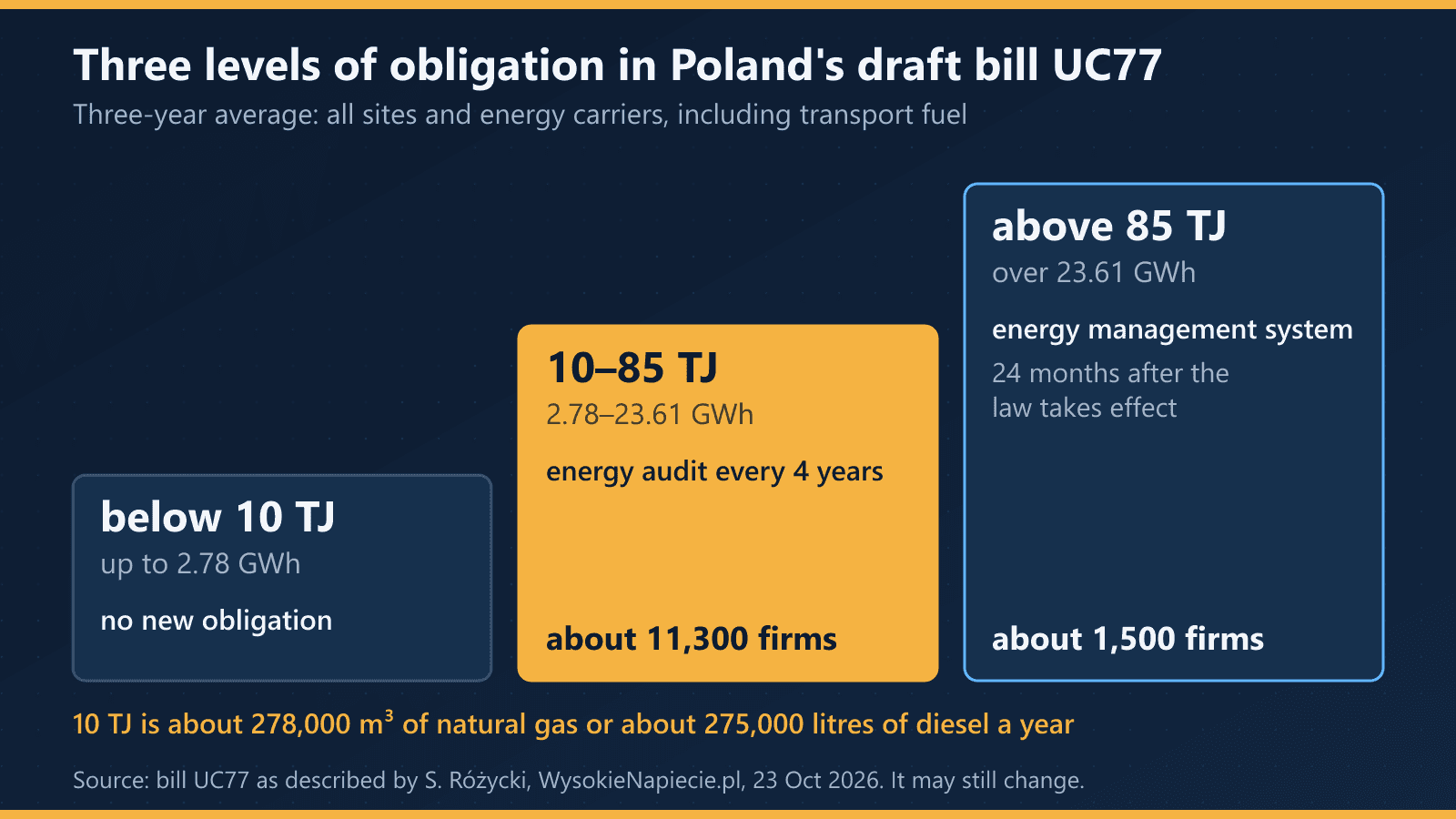
The figure is a three-year annual average, added up across all sites and carriers, fuel in company vehicles included. That is why 10 TJ arrives sooner than an electricity meter alone would suggest: it equals about 278,000 m³ of natural gas or about 275,000 litres of diesel a year. Estimates quoted in the same article put roughly 1,500 firms in the management system tier and roughly 11,300 in the audit tier, many of them mid-sized companies that have never had an audit.
The consultation round softened the draft in several places:
- Energy management system: 24 months after the law takes effect. The directive says 11 October 2027, but since the law is not yet in force, by our arithmetic the Polish date cannot fall before autumn 2028.
- Post-audit action plan: simpler, with no annual updates.
- Energy performance contract exemption: narrower, available only with a full management system.
- Auditors: a certificate from PCA-accredited bodies instead of an exam, mandatory liability insurance, and a four-year transition for people meeting the earlier criteria.
- First audit: transition periods are planned for firms doing one for the first time, but the ministry will only give their length in the next version of the draft.
The regulatory impact assessment puts an average audit at about PLN 100,000 and a management system with metering at about PLN 1 million, with a simple payback of about three years. Różycki cautions that the draft may still change, so treat all of these as an October 2026 snapshot.
Why waiting has a price
On 19 October Eurostat released data for the first half of 2026. In consumption band ID, 2 to 20 GWh of electricity a year, the price excluding VAT and other recoverable taxes and levies was 18.12 ct/kWh in Poland, or PLN 0.77/kWh. The EU average was 15.59 ct, Germany 17.42 ct (provisional) and Czechia 14.58 ct.
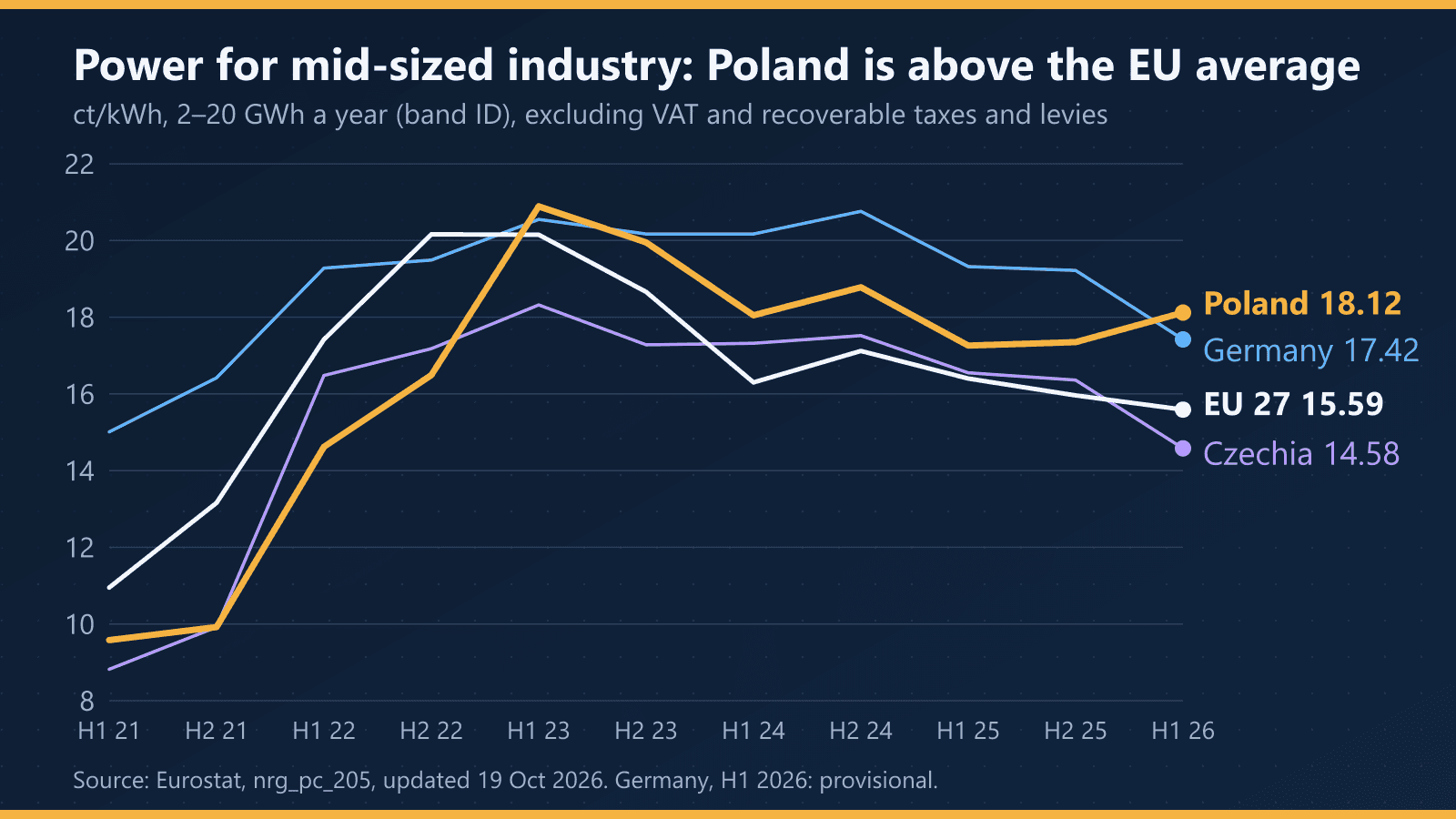
In five years Poland has moved from below the EU average to above it. In the first half of 2021 the Polish price was 12.5% lower; in the first half of 2026 it was 16.2% higher. Over the latest half-year it rose 4.4% while the EU average fell 2.3%, Germany fell 9.4% and Czechia fell 10.9%.
These figures have limits. They are band averages, not what any given plant pays, and they say nothing about why the gap exists, whether contracts, charges or relief schemes. What they do show is direction: against its neighbours, the same kilowatt-hour is costing a Polish plant more.
What that means in money
Here is an illustrative scenario, and the estimate is ours. A firm just over the threshold uses 2,778 MWh a year. If all of it were electricity at the band ID average of PLN 0.7685/kWh, the bill would be about PLN 2.13 million a year, and each percentage point saved would be worth about PLN 21,000. A PLN 100,000 audit would pay for itself across a four-year cycle at savings of about 1.2% a year. Treat that bill as an upper bound, since a real plant buys part of its energy as gas or other fuels at different prices.
For a benchmark, the International Energy Agency reviewed more than 300 energy management case studies in 40 countries and found average energy savings of 11% within the first years of implementation, with companies still improving after 12 years. That is an average across many sectors rather than a forecast for your site, and it describes a management system, not a one-off audit.
An audit starts with data
Article 37 of the current Polish Act is specific about the raw material: audits must rest on up-to-date, representative, measured and identifiable data on energy use and, for electricity, on power demand. The review must cover the buildings, industrial installations and transport that together account for at least 90% of the company's energy use, and the records must be kept for five years. The Commission's recommendation notes that where Member States set such a minimum share, it typically sits between 65% and 90%, so Poland is at the top of the range.
An electricity invoice gives you one number a month. It shows neither power demand nor what the plant does overnight and at weekends.
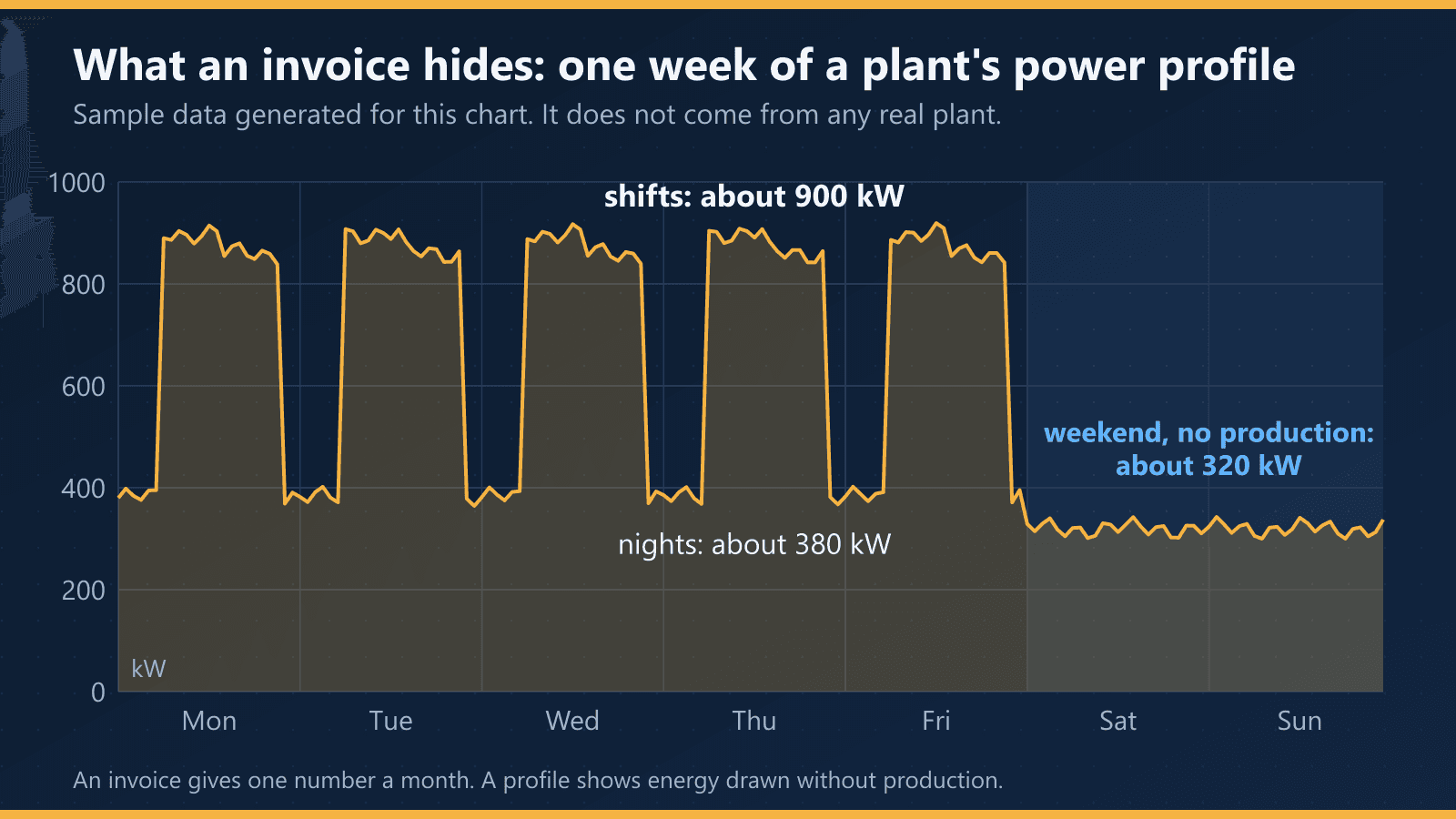
The chart above uses sample data. In it, about 30% of the week's energy falls outside production shifts. Without a profile you never see that number, and it is the number that starts the conversation about equipment running while nothing is being made.
Metering also needs to catch what tends to fall out of the balance. CEET names two common omissions: biomass from a plant's own waste and district heat. And under the UC77 description, transport fuels count towards the threshold too.
Who has already done this
Press Glass announced in July 2025 that it had implemented ISO 50001 across all its production sites in Poland, as part of an integrated system with ISO 9001 and ISO 14001. Rosti Poland, a plastic injection moulder, announced its certificate in September 2024. Neither statement gives a result in percent or megawatt-hours, so they prove nothing about payback. They do show that certification in a Polish factory is no longer an experiment.
Barriers and limits
- The law can still move. The thresholds come from the directive, but Polish dates and transition periods remain open.
- Metering costs money and time. The PLN 1 million estimate covers a system with measurement, and implementation takes about a year. A plant that starts only when the Act is published will have no measurement history of its own at that point.
- An audit saves nothing by itself. The directive calls for an action plan, and both the plan and the rate of implementation are meant to appear in the company's annual report and be publicly available. The Polish draft simplifies the plan, but savings only come from carrying out the recommendations.
- Measurement does not replace judgement. A power profile shows when energy flows. People in maintenance and production still have to find the cause and the fix.
What to do now
- Work out your three-year average. All sites, all carriers, transport fuel included, converted to TJ (1 MWh is 0.0036 TJ).
- Establish your status. A large company checks that it is keeping to its four-year cycle under the current rules, whatever happens to UC77. A mid-sized one above 10 TJ prepares for the new duty.
- Check your metering coverage. Identify which loads make up 90% of your use, and whether each has its own meter rather than a value derived from other readings.
- Start collecting a power profile. Audits rest on representative data, and a full year captures seasons and shutdowns. A year is our recommendation, not a statutory requirement.
- Choose a route. Różycki lists three: an audit, ISO 50001 or an environmental management system. For the last two, allow about a year.
Where OmniEnergy helps
OmniEnergy, the energy module of OmniMES, collects readings from electricity, gas, compressed air and water meters over MQTT Sparkplug B, stores them in TimescaleDB and ties them to machines in the plant structure. From there it flags significant energy uses, calculates energy performance indicators and prepares reports for the ISO 50001 review. We walk through this in OmniEnergy in practice, and the background to the directive is in our article on the EED.
The limits are simple. The system does not carry out audits or issue certificates, and a machine without a meter will not appear in it. It supplies measured, repeatable data for the auditor and your team to work with. There is more on the OmniEnergy page.
Sources
- Directive (EU) 2023/1791 of the European Parliament and of the Council, Article 11 — https://gesetze.legal/eu/rl_2023_1791_eu/11
- Commission Recommendation (EU) 2024/2002 — https://energiaitalia.news/wp-content/uploads/2024/08/recommendation-2024-2002.pdf
- Act of 20 May 2016 on energy efficiency, Journal of Laws 2025, item 711, Articles 36–40 — https://api.sejm.gov.pl/eli/acts/DU/2025/711/text.pdf
- Sławomir Różycki, Efektywność energetyczna: nowe obowiązki dla firm, WysokieNapiecie.pl, 23 Oct 2026 — https://wysokienapiecie.pl/122324-efektywnosc-energetyczna-nowe-obowiazki-dla-firm/
- Government Legislation Process, bill UC77 — https://legislacja.rcl.gov.pl/projekt/12402653
- Chancellery of the Prime Minister, legislative work list, UC77 — https://www.gov.pl/web/premier/projekt-ustawy-o-zmianie-ustawy-o-efektywnosci-energetycznej-oraz-niektorych-innych-ustaw4
- KAPE, Projekt nowelizacji Ustawy o Efektywności Energetycznej, 2025 — https://kape.gov.pl/blog/aktualnosci-kape-1/projekt-nowelizacji-ustawy-o-efektywnosci-energetycznej-nowe-obowiazki-dla-przedsiebiorstw-i-samorzadow-748
- European Commission, November 2025 infringements package, reprinted statement — https://www.pubaffairsbruxelles.eu/eu-institution-news/commission-takes-action-to-ensure-complete-and-timely-transposition-of-eu-directives-2/
- European Commission, June infringements package: key decisions on energy, 2026 — https://energy.ec.europa.eu/news/june-infringements-package-key-decisions-energy-2026-06-04_en
- European Commission, October infringements package: key decisions on energy, 2026 — https://energy.ec.europa.eu/news/october-infringements-package-key-decisions-energy-2026-10-01_en
- Eurostat, Electricity prices for non-household consumers, nrg_pc_205, updated 19 Oct 2026 — https://doi.org/10.2908/NRG_PC_205
- IEA, Industrial facilities could save billions by implementing energy management, 1 July 2025 — https://iea.org/commentaries/industrial-facilities-could-save-billions-by-implementing-energy-management
- CEET, Audyt energetyczny przedsiębiorstwa od 2026 roku: nowe obowiązki, stare błędy, 7 May 2026 — https://ceet.pl/audyt-energetyczny-przedsiebiorstwa-od-2026-roku-nowe-obowiazki-stare-bledy/
- Press Glass, Press Glass has implemented ISO 50001, 1 July 2025 — https://www.pressglass.com/press-glass-has-implemented-iso-50001/
- Rosti, Rosti Poland achieves ISO 50001 certification, 21 Sept 2024 — https://www.rosti.com/resources/news/rosti-poland-achieves-iso-50001-certification/