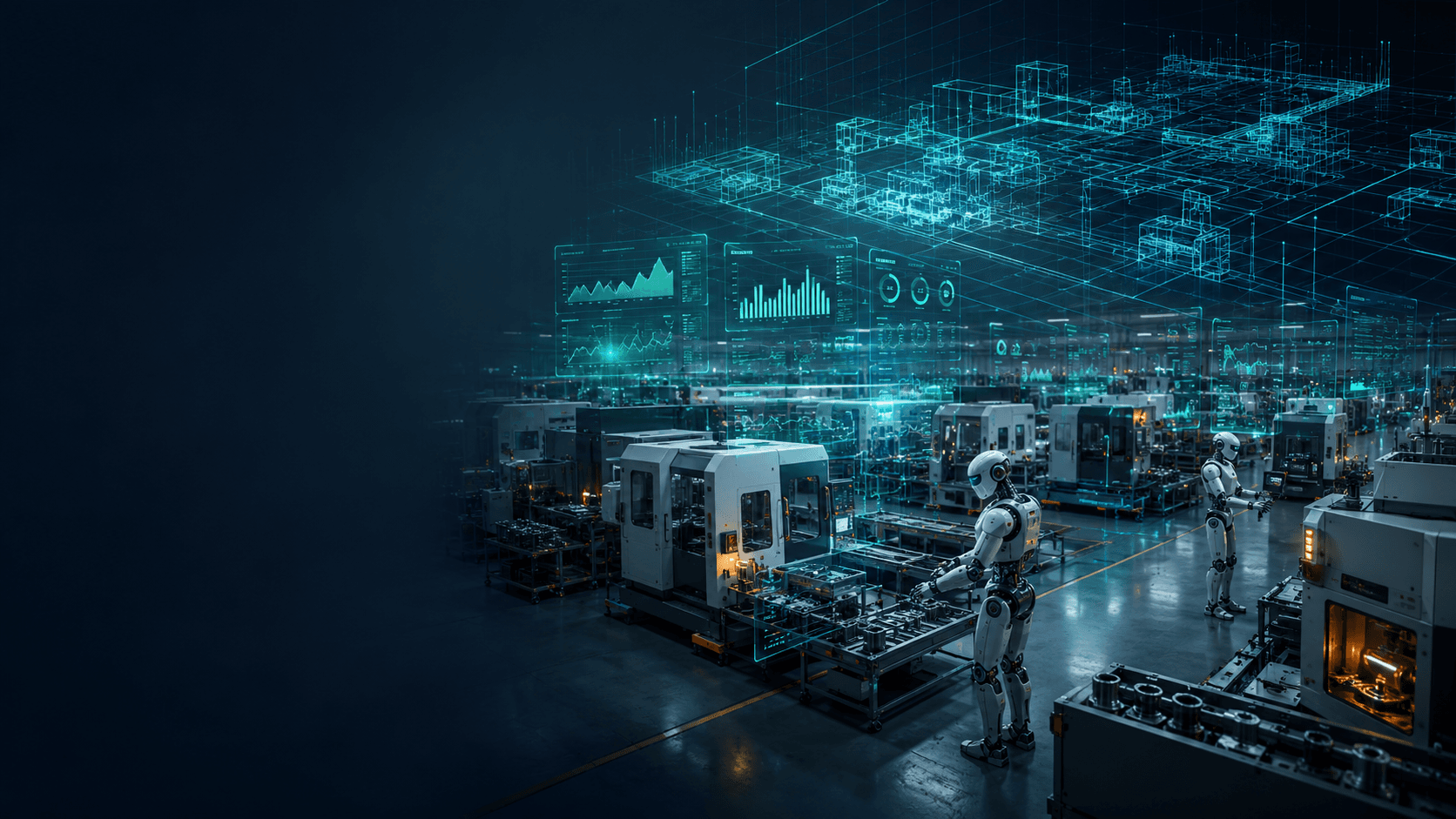
2 June 2026, Taipei. Jensen Huang opened Computex 2026 with a three-hour keynote in which, for the first time in the conference's history, the majority of his time went to industrial topics — robotics, AI factories, digital twins. Consumer GPUs got ten minutes at the end. AMD fired its own press conference four hours later, Intel the next morning. Three keynotes, more than a dozen announcements, one clear conclusion: edge AI on the factory floor is leaving the pilot phase.
From an MES perspective — five items in this wave actually move the 2027 technology map. Not everything in the keynote matters to a manufacturing plant, most was demo, but the five below have a concrete production pipeline in a 12-month horizon.
1. GR00T N1.5 — robot foundation model goes production-grade
NVIDIA first showed Project GR00T in March 2024 as a training platform for humanoids. GR00T N1 (March 2026) was the first version with open weights — a generic manipulation policy trained on 10,000 hours of demonstrations from FANUC, ABB, and Boston Dynamics. GR00T N1.5, unveiled on 2 June, is the first version NVIDIA positions as production-grade.
What actually changed from N1 to N1.5:
- 300% more training data, mostly from synthetic data generated in Cosmos (see #2)
- Zero-shot manipulation across 50+ gripper types — from two-finger to suction to multi-finger
- 80 ms prediction latency on Jetson Thor (was 220 ms on Jetson Orin AGX)
- TwinCAT and Beckhoff support in the default deployment kit — critical for European industry
What it means for MES: for the first time, robot–MES integration does not require trajectory programming. The operator shows the robot what they want in VR/AR (teleoperation, 5–10 demonstrations), the MES stores the task as a prompt plus few-shot demonstrations. Next time the same product variant appears on the line, the robot pulls the prompt from MES and generates the trajectory in real time.
Realistic timeline: Q4 2026 first production pilots at large OEMs (VW, Mercedes, BMW). 2027 availability for mid-sized manufacturers via integrators (FANUC and KUKA already have partnerships). For a European automotive plant — realistic POC start date: early 2027.
2. Cosmos 2.0 — world model for synthetic training data
NVIDIA released Cosmos in January 2025 as a foundation model for generating synthetic 3D scenes. Version 1.0 produced physics-aware video sequences, useful mainly for training autonomous-driving models. Cosmos 2.0 adds diff-rendering: you can drop in your own CAD objects (e.g. a missing gripper variant, a new packaging type) and Cosmos will generate hundreds of thousands of realistic scenes with that object under varied lighting, angles, and positions.
What it means for computer vision on the shop floor: until now, deploying a defect-detection model for a new SKU required 3–6 months of data collection and labelling from real production. With Cosmos 2.0 — 5–10 days of synthetic rendering plus 200–500 real photos for fine-tuning. A 80–90% reduction in time-to-deployment for a new computer-vision use case.
NVIDIA showed a concrete demo with a sensor manufacturer: from a new SKU idea to a production CV model in 11 days (vs the previous 4 months in the same plant under the prior process).
Limit: synthetic quality depends on CAD accuracy and PBR shaders. For a typical European manufacturer that means: if your CAD is modern (SolidWorks 2024+, Fusion 360) with detailed materials, Cosmos 2.0 works. If your CAD is legacy without textures — invest in the CAD pipeline upgrade first.
3. Omniverse Replicator + Mega ABBP — multi-agent factory simulation
The previous Omniverse Replicator generated synthetic images for CV. The new version, shown in a demo with ABB and Boston Dynamics ("Mega ABBP"), is a multi-agent simulator of an entire factory — a virtual copy of the shop floor in which 10–100 robots (from different vendors), AGVs, humans, and conveyors operate in parallel. All driven by the real MES — the same one that will run the physical factory after deployment.
What it means for greenfield and brownfield projects: layout and MES-logic validation before pouring concrete (greenfield) or before delivering new machines (brownfield). NVIDIA presented a BMW iFactory case — 8 weeks of simulation instead of 18 months of iterative post-go-live fixes.
Practical observation: existing factory simulators (Tecnomatix Plant Simulation, FlexSim, AnyLogic) are good at production-flow logic but weak at robot physics and AI. Omniverse plus Mega is the first time those two layers merge in one tool. The enterprise licence price was not announced — earlier Omniverse Enterprise was around USD 9,000/seat/year, likely similar or higher.
For a mid-sized European plant this is not realistic yet — unless you are a direct supplier to an OEM and the OEM funds the simulation.
4. AMD Ryzen AI Max+ Pro — Jetson Orin gets a competitor
AMD revealed Ryzen AI Max+ Pro — a laptop chip with 96 GB unified memory, a 50 TOPS NPU, integrated RDNA 4 Radeon. The point that matters for MES: vendor reference price around USD 1,200, capable of running a local Llama 3.3 70B at full precision (no quantization) or Phi-4 14B plus a Vision Language Model in parallel.
Comparison with Jetson Orin AGX 64 GB:
- Price: AMD ~USD 1,200 vs NVIDIA ~USD 1,999
- RAM: 96 GB vs 64 GB
- Power: 120 W vs 60 W (AMD worse)
- Edge form factor: AMD needs a laptop or mini-PC, Jetson is natively embedded
- Software stack: AMD ROCm 7.0 vs NVIDIA CUDA — in 2026 ROCm finally handles most HuggingFace models without modification
What it means for MES: for edge AI in the maintenance office, in the plant server room, or for a dedicated AI assistant per production line — AMD Ryzen AI Max+ is 40% cheaper than Jetson AGX with 50% more RAM. For deployment on the shop floor itself, in dust and at 50°C, Jetson still wins on form factor and power draw.
First partner products (HP, Lenovo industrial workstations) announced for September 2026. For us — Q4 2026 / Q1 2027 procurement-planning window.
5. Intel Gaudi 3 + OpenVINO 2026 — ML inference cost drops 60%
Intel showed Gaudi 3 for edge inference (previously data-center only), in a PCIe form factor — it slots into any 1U server. Plus a new OpenVINO 2026 with native optimization for TimesFM, Chronos, and the other time-series foundation models I covered in the previous article.
Measured numbers from the keynote: failure prediction for 200 sensors every 5 seconds — Gaudi 3 draws 18 W and costs USD 2,400, matching the throughput of an A100 server (USD 25,000). That's a 10x lower CAPEX for a typical MES analytics pipeline.
Intel showed a Foxconn case — 4,000 sensors on an iPhone plant, one Gaudi 3 server replacing a stack of three GPU servers. Annual electricity savings: USD 28,000.
For a mid-sized European plant (50–200 sensors) this is a real alternative to a GPU server for local ML — with an estimated project hardware budget of EUR 5–10k instead of EUR 50k for the NVIDIA equivalent.
What actually changes for a European manufacturer in 12 months
Three concrete implications:
First, the cost of edge AI on the factory floor drops by half. AMD Ryzen AI Max+ and Intel Gaudi 3 are not cosmetic — they shift the economics fundamentally. Local LLM, local multimodal AI, local ML pipelines — in 2027 the CAPEX will be in the USD 1–5k range, not USD 20–50k. That opens access to plants with 50–200 staff for which only the cloud was previously economic.
Second, computer vision for new SKUs moves from months to weeks. Cosmos 2.0 plus Omniverse Replicator cuts the cycle from "we have a new product variant" to "MES detects defects" by 80%. That changes the calculus for low-volume plants — previously CV did not pay back for variants under 5,000 units, now the threshold drops to around 500.
Third, robot–MES integration stops requiring a robot programmer. GR00T N1.5 in 2027 (realistic deployment) changes the integrator's role from "spend a week tuning the pick-and-place trajectory" to "teach the robot a new variant in 30 minutes of demonstration". That cuts the per-unit cost of a variant change by 5–10x.
Limits and what the keynote didn't show
Five items that deserve an honest comment:
Demo vs production. GR00T N1.5 in the on-stage demo sorts Tetris blocks with 99% recall. In a real factory, in dust and under variable lighting, those metrics drop. NVIDIA did not show a "one year in real production" demo — the industry is still missing that.
Infinite price tag for Omniverse Enterprise. The Mega ABBP demo was spectacular, but licensing Omniverse remains out of reach for mid-sized manufacturers. Waiting for an "Omniverse for SMB" tier that NVIDIA did not announce.
No SLA for foundation models. GR00T is open weight, which also means "no SLA". For integration in a robot control loop, where a model failure equals a line stop, this is a serious problem. The standard workaround is a fallback (classical rules if the foundation model doesn't trust its prediction), but that is an additional layer to build.
Vendor lock-in. CUDA, ROCm, oneAPI — three ecosystems, weak interoperability. If you invest in the Jetson stack today, migrating to AMD or Intel in three years will be costly. Open Neural Network Exchange (ONNX) helps, but does not solve the problem 100%.
Nothing for mid-sized integrators. All demos were with TIER-1 OEMs (VW, BMW, Foxconn). NVIDIA and AMD did not show a path for regional integrators, who handle 80% of the European mid-market MES space. That gap will probably close through 2027 (when distributors start offering preconfigured boxes), but today planning a deployment requires more risk than for a TIER-1.
Takeaways for the production director and CIO
Short term (Q3–Q4 2026): start a conversation with your integrator about a pilot of one use case on the new stack. Safest path: Intel Gaudi 3 for failure prediction (smallest change to the pipeline, fastest ROI). AMD Ryzen AI Max+ as a local LLM assistant — second choice.
Medium term (2027): plan the investment budget for the second wave of edge AI. Cosmos 2.0 plus a new CV pipeline for variant-heavy products. GR00T N1.5 for one pilot cell with a cobot.
Strategic (by 2028): consider exiting cloud LLMs for production data. The local stack on the new hardware becomes cheaper, faster to respond, and fundamentally simpler under NIS2 compliance (covered in the NIS2 article).
Computex 2026 was not a revolution in the ChatGPT-2022 sense. It was a series of incremental announcements that together change the edge-AI economics for the mid-sized manufacturer. The next 12 months will decide who moves first on the new economics — and whether mid-market European manufacturers will be in time before TIER-1 competitors compound their lead further.
Sources
- NVIDIA Project GR00T — product page, technical documentation
- NVIDIA Cosmos — world-model product page, synthetic-data blueprint
- NVIDIA Omniverse Enterprise — licensing and case studies
- AMD Ryzen AI Max+ announcement (Computex 2026) — specification and partnerships
- Intel Gaudi 3 PCIe (Computex 2026) — Foxconn benchmark case study
- OpenVINO 2026 release notes — TimesFM and Chronos optimization
- Time-series Foundation Models in MES — our earlier TSFM article
- NIS2 and the Polish KSC2 Act in 2026 — regulatory context for local AI