On 5 November the Polish Sejm accepted the Senate's amendments to the act on support for energy-intensive businesses for the cost of electricity. The scheme puts PLN 4.8bn of electricity support on the table for 2027–2030, and the act now awaits the president's signature. The biggest change of the past fortnight is how the money is shared: a proportional split replaces a competitive contest.
For a plant, though, this is not a simple subsidy. At least half of the aid received has to be invested within 48 months in demand flexibility, electrification, energy efficiency or renewables. Anyone planning to apply therefore needs to know their consumption and what they will turn it into. Below we explain the mechanism from the text of the act, work through an example, and list the data worth collecting before the first call opens.
Poland is not alone here. The scheme sits on two EU state-aid frameworks: section 4.5 of the Clean Industrial Deal State Aid Framework (CISAF), which allows electricity price relief for energy-intensive users, and the temporary Middle East Crisis framework (METSAF) adopted on 29 April 2026. Plants in other member states running similar schemes face the same trade-off between relief now and investment later.
What was passed
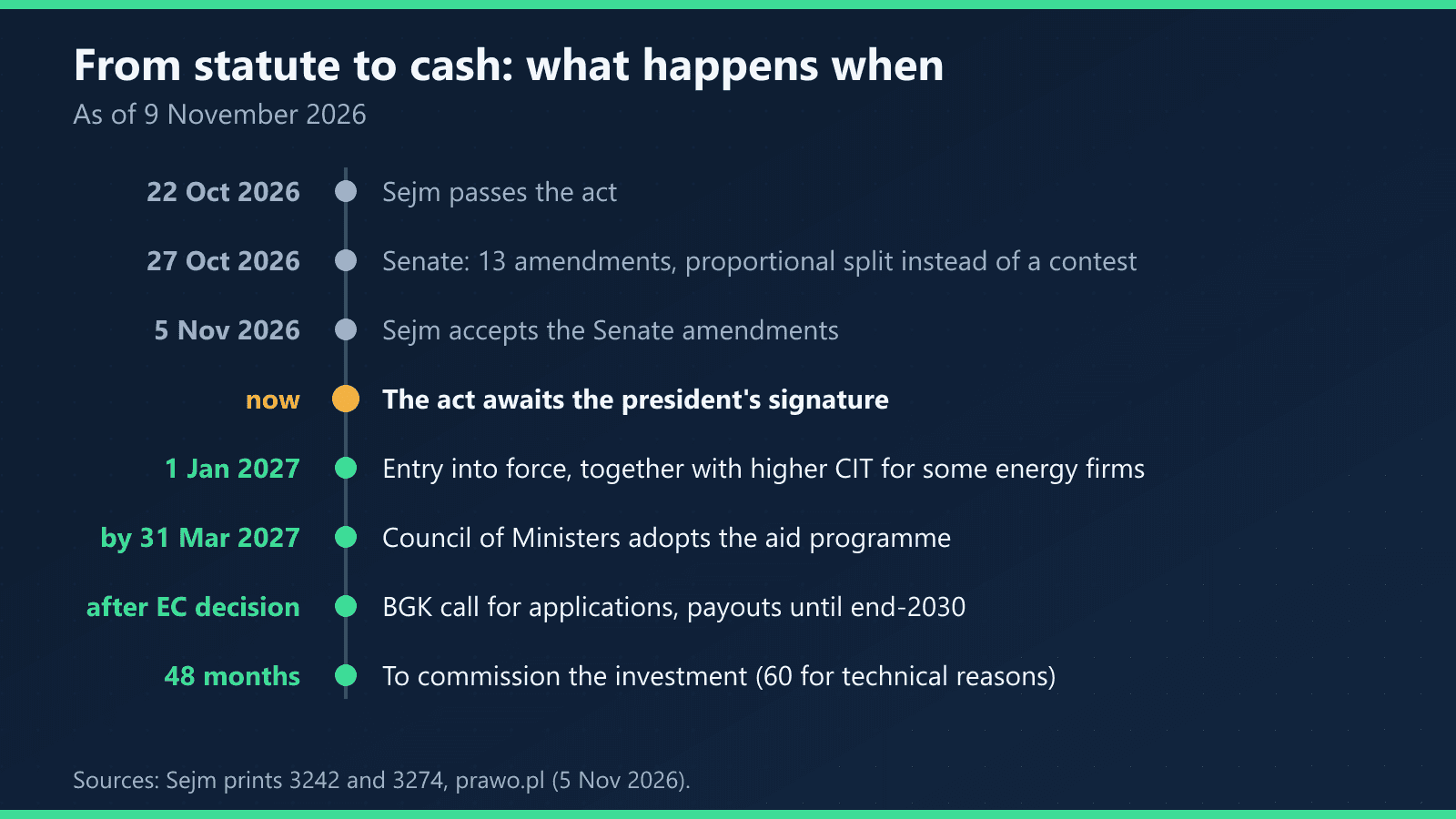
The Sejm passed the act on 22 October by 230 votes to 64, with 145 abstentions. On 27 October the Senate added 13 amendments. The key one swaps the contest for a proportional split: if applications exceed the pool for a call, every payout is cut by the same proportion. The Senate argued that EU rules do not require a contest and that comparable schemes elsewhere in the EU run without one. HIPH, the Polish steel industry chamber, had estimated that under the contest only about 7 of 350 eligible firms would get money, and press reports said the president was weighing a veto over the contest.
The Senate also dropped the requirement to describe the investment in the application, removed the technical evaluation report requirements from the programme, and added renewables financed through a long-term power purchase agreement (PPA) to the list of eligible investments. A beneficiary must report completion to the aid operator within 3 months of the investment deadline. The Sejm accepted all of the amendments on 5 November.
The act is due to take effect on 1 January 2027. The money comes from the state budget, and the same act raises corporate income tax for the largest firms in oil and gas extraction, fuel trading and power transmission (revenue above €50m): 30% in 2027, 26% in 2028, 23% in 2029 and back to 19% from 2030.
Who qualifies
Under Article 7, a firm must meet all of the following:
- more than 50% of its business revenue in the year before applying comes from activities listed under one of the 109 Polish PKD codes in the act's annex, which span mining, food processing, paper, chemicals, glass, ceramics and metals, among others;
- it is an industrial consumer on the register kept under Article 52(4) of Poland's Renewable Energy Sources Act;
- it ran that activity throughout the qualifying period and still runs it when applying;
- it is not in liquidation, insolvency or difficulty as defined in EU guidelines, and owes no tax or social security arrears.
The minister responsible for the economy grants the aid. Bank Gospodarstwa Krajowego (BGK), the state development bank, runs the calls and pays out as the aid operator.
How the support is calculated
Article 3 sets the mechanism:
- Qualifying consumption is 50% of the electricity a firm bought and used in the qualifying period, the calendar year before the application.
- Support per MWh may not exceed 50% of the RK price, the average of the quarterly competitive-market electricity prices published by Poland's Energy Regulatory Office.
- Price floor: support may not push the price of that power below €50/MWh, converted at the National Bank of Poland's average rate on the last day of the qualifying period.
- Duration: support covers at most three consecutive years.
For power used from 1 March to 31 December 2026, Article 28 lets the cap be raised in 2027 by up to 20 percentage points, to 70% of the RK price. This follows METSAF, and the extra amount does not count towards the investment obligation.
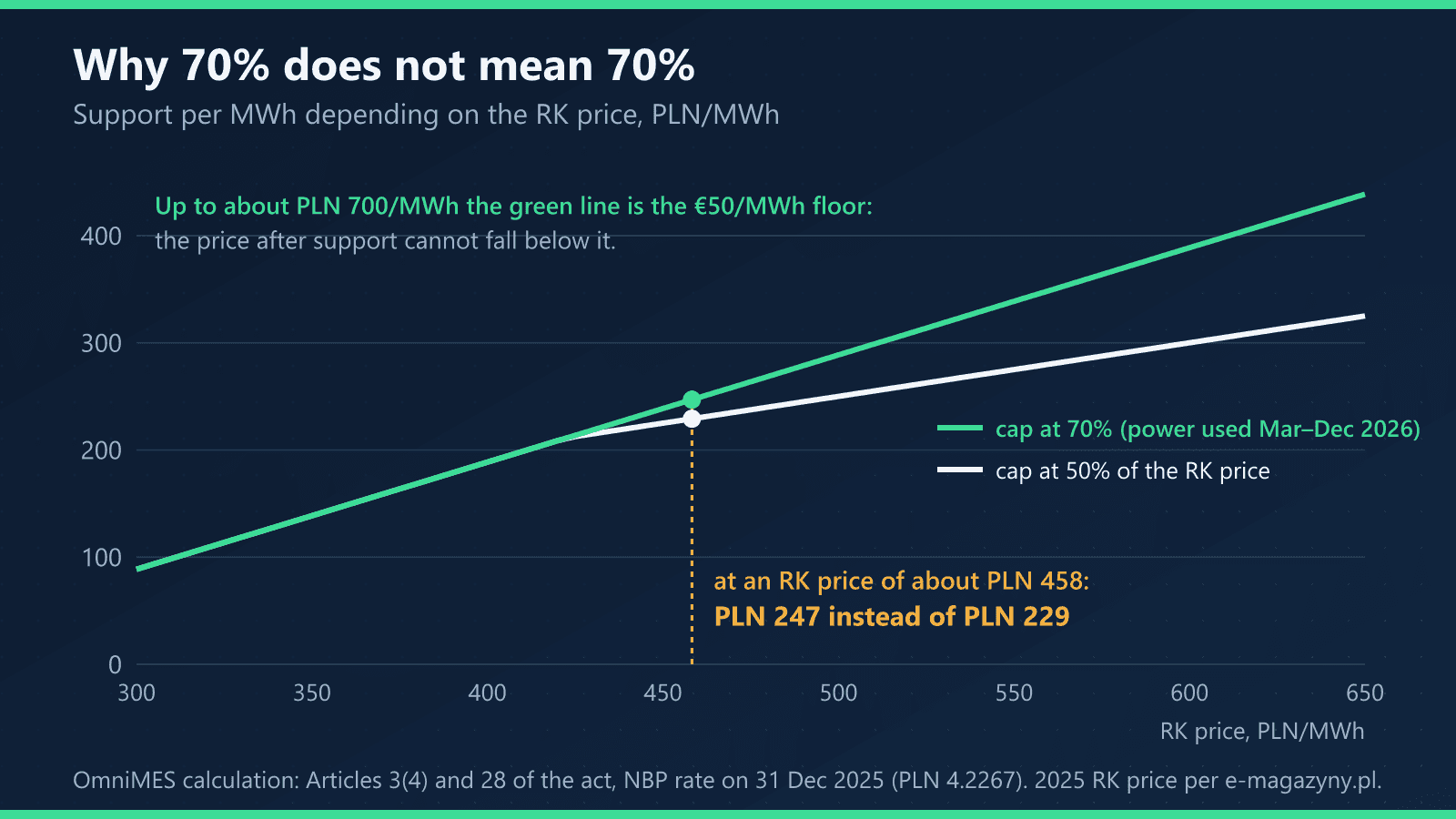
The chart shows something easy to miss. At the NBP rate on 31 December 2025 (PLN 4.2267), the €50 floor works out at PLN 211.34 per MWh. With an RK price of about PLN 458, the 2025 average as calculated by e-magazyny.pl, a 50% cap gives PLN 229 per MWh. A 70% cap would give PLN 321, but that would push the price below the floor, so support stops at PLN 247. In this example the higher cap adds roughly PLN 18 per MWh, not PLN 92. This is our calculation: for 2026 consumption the 2026 average RK price and the euro rate on 31 December 2026 will apply, and neither is known yet.
The act also handles overlap. A firm that already receives compensation for indirect emission costs under Poland's 2019 act for the same period can only get the new support for consumption not covered by that compensation, or for the difference up to the maximum amount (Article 4).
The investment obligation in numbers
Article 3(9) requires at least 50% of the total support to go into an investment in Poland, commissioned within 48 months of the support being granted, or 60 months for objective technical reasons. The investment must lower the cost of running the power system or meet power market needs, and must not increase fossil fuel use. The act lists:
- investments that raise demand-side flexibility, so consumption can follow market or system operator signals;
- electrification and energy efficiency;
- renewables and their integration with the firm's consumption profile, including through PPAs;
- infrastructure that lets the plant's installations run flexibly and safely.
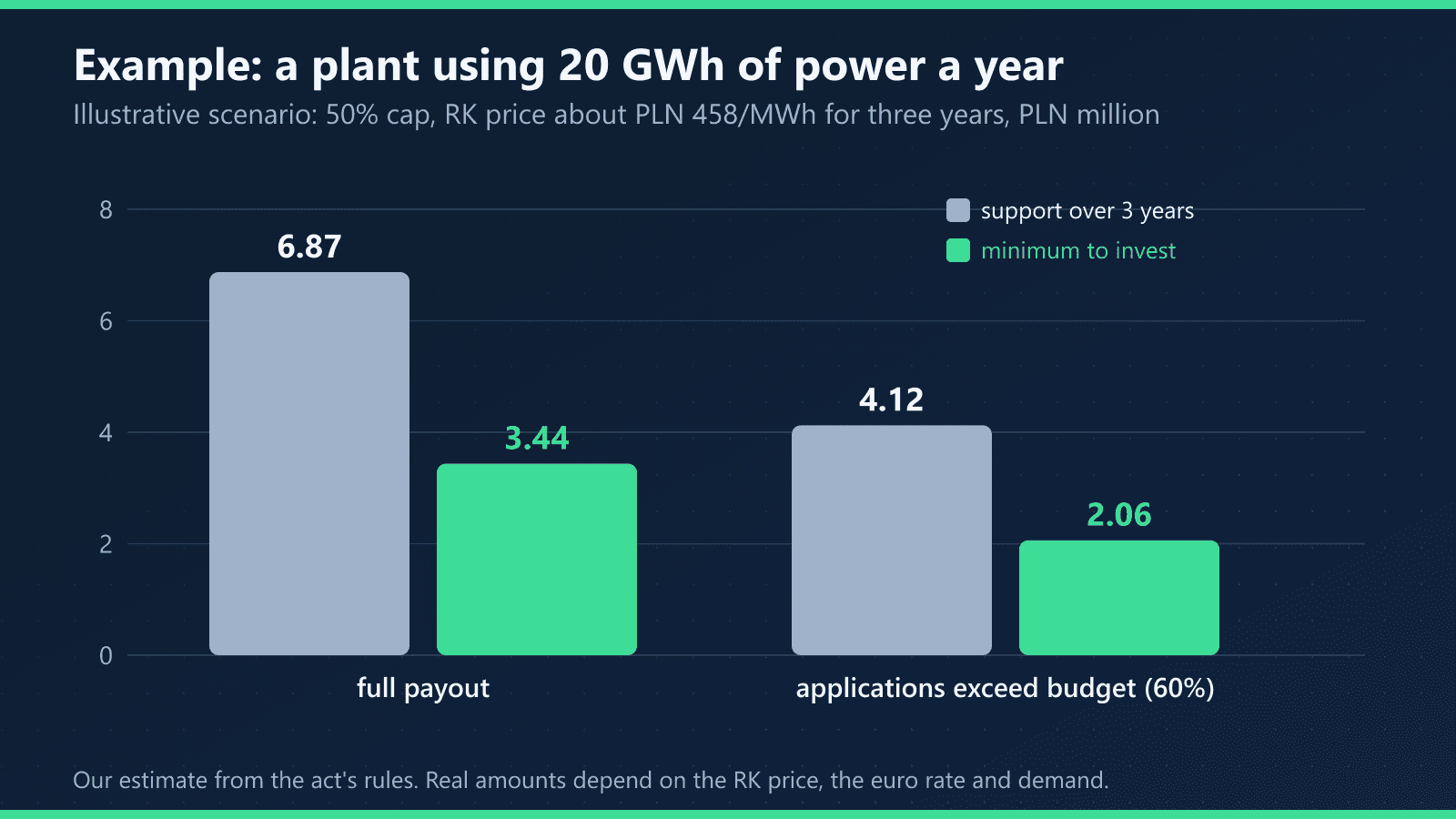
Here is an illustrative scenario, and the numbers are our estimate. A plant buys and uses 20 GWh a year, so qualifying consumption is 10 GWh. With a 50% cap and an RK price of about PLN 458, support comes to about PLN 2.29m a year: PLN 6.87m over three years, with at least PLN 3.44m to invest. If applications exceed the pool and payouts are cut to 60%, the plant receives PLN 4.12m and must invest at least PLN 2.06m. After the Senate's amendment, total support means the sum actually paid out, so the investment obligation shrinks with the payout.
Where the data comes in
The act says nothing about metering, but several of its rules are hard to meet without good data:
- Power bought and used. Support is based on electricity bought and used in the previous year. A plant with its own generation, solar for example, has to separate bought power from self-generated power. The Senate debate turned on exactly how to treat firms that produce energy for their own use.
- Demand flexibility. An investment in matching consumption to market signals starts with knowing which loads can move in time, and by how much. Without a power profile, ideally in 15-minute intervals, you cannot judge that.
- Renewables matched to the profile. The act refers explicitly to integrating renewables with the firm's consumption profile. Sizing an installation or a PPA means knowing that profile across working days, weekends and seasons.
- Proof of effect. The aid operator can inspect how the agreement is carried out, with access to documents and data (Article 22). The minister publishes a report on the investments by 30 June each year (Article 24), and aid granted improperly must be repaid with interest (Article 25). Measuring before and after, energy per unit of output for example, is the simplest evidence that an investment did what it was meant to.
Barriers and unknowns
- The president's signature. The act still needs it. The contest that prompted veto reports has been removed by the Senate.
- European Commission approval. Article 30 states that no support is granted until a positive Commission decision is announced.
- The government programme. The detailed investment types, criteria and frequency of calls will be set in a programme the Council of Ministers must adopt within 3 months of the act taking effect.
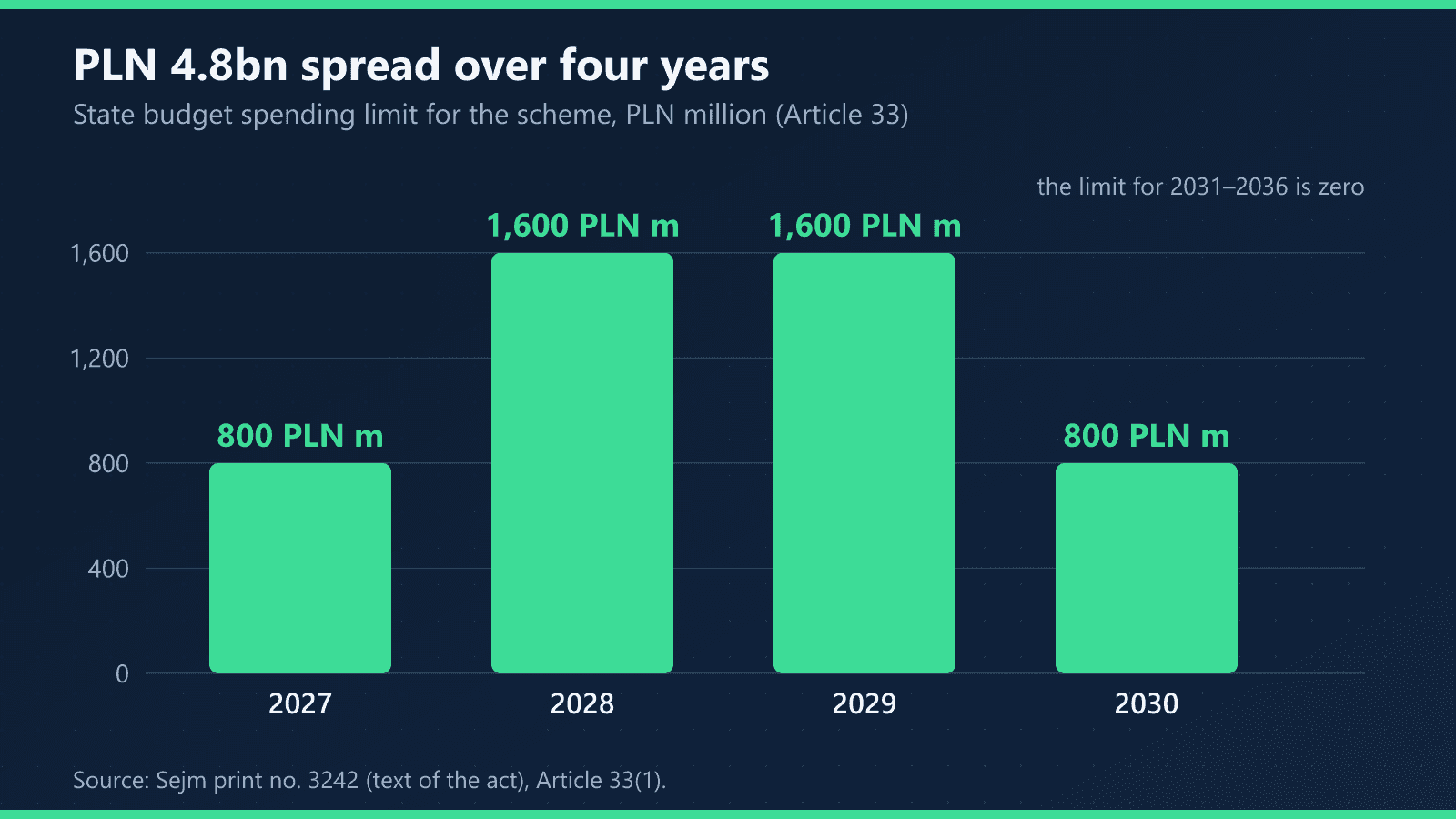
- Payout size. A proportional split means that with many applications everyone receives less than the formula suggests. The 2027 pool is PLN 800m.
- The €50 floor. At RK prices similar to 2025, raising the cap to 70% delivers far less than the headline figure.
- Own funds. The investment must be commissioned within 48 months, while the support arrives spread over three years.
What to do before the first call
- Check eligibility: the share of revenue from the annex's PKD codes and the industrial consumer register entry.
- Calculate power bought and used in 2026 for each site, separately from self-generated power.
- Check overlap with indirect emission cost compensation if the firm already receives it.
- Start collecting the power profile of the main loads, to show what can be shifted in time and to size renewables to consumption.
- Set a baseline for energy per unit of output before the investment starts, and track it monthly.
- Watch for the president's signature, the government programme and the Commission's decision. The date of the first call depends on all three.
Where OmniEnergy helps
OmniEnergy, the energy module of OmniMES, collects readings from electricity, gas, compressed air and water meters over MQTT Sparkplug B, stores them in TimescaleDB and assigns them to machines, lines and sites. It shows the consumption profile, flags significant energy uses and calculates energy per unit of output. That is the data you need to choose an investment from the act's list and later show its effect. We cover the details in OmniEnergy in practice. Two weeks ago we also wrote about the energy audit deadline under the EED, which will often be a good starting point for that investment list.
OmniEnergy will not check whether a firm qualifies, will not prepare an application and does not replace an adviser. It provides measured, repeatable consumption data to base those decisions on. There is more on the OmniEnergy page.
Sources
- Polish Sejm, print no. 3242: committee report with the text of the act on support for energy-intensive businesses for the cost of electricity — https://api.sejm.gov.pl/sejm/term10/prints/3242/3242.pdf
- Polish Senate, resolution of 27 Oct 2026 on the act (print no. 3274) — https://api.sejm.gov.pl/sejm/term10/prints/3274/3274-uchwa%C5%82a.docx
- Polish Sejm, print no. 3159: government bill with explanatory memorandum — https://api.sejm.gov.pl/sejm/term10/prints/3159/3159-uzasadnienie.docx
- Prawo.pl, Ustawa o wsparciu przedsiębiorstw energochłonnych, 5 Nov 2026 — https://www.prawo.pl/biznes/ustawa-o-wsparciu-przedsiebiorstw-energochlonnych,1555729.html
- Energetyka24, Sejm przyjął ustawę o wsparciu dla przemysłu energochłonnego. Kto otrzyma pomoc?, 23 Oct 2026 — https://energetyka24.com/gospodarka/przemysl/sejm-przyjal-ustawe-o-wsparciu-dla-przemyslu-energochlonnego-kto-otrzyma-pomoc
- WNP.pl, 4,8 mld zł na pomoc dla polskiego przemysłu. Senat odsyła ustawę, 27 Oct 2026 — https://www.wnp.pl/przemysl/4-8-mld-zl-na-pomoc-dla-polskiego-przemyslu-senat-odsyla-ustawe,1113384.html
- Zero.pl, Wsparcie dla firm energochłonnych. Senat zmienia ustawę, w tle groźba prezydenckiego weta, 28 Oct 2026 — https://zero.pl/news/wsparcie-dla-firm-energochlonnych-senat-zmienia-ustawe-w-tle-grozba-prezydenckiego-weta
- e-magazyny.pl, Rząd zmienia zasady wsparcia dla przemysłu. Firmy mogą dostać więcej za energię zużytą w 2026 r., 25 Sept 2026 — https://e-magazyny.pl/eksperckim-okiem/rzad-zmienia-zasady-wsparcia-dla-przemyslu-firmy-moga-dostac-wiecej-za-energie-zuzyta-w-2026-r/
- European Commission, Middle East Crisis Temporary State Aid Framework (METSAF) — https://competition-policy.ec.europa.eu/state-aid/legislation/metsaf_en
- National Bank of Poland, euro average rate on 31 Dec 2025 — https://api.nbp.pl/api/exchangerates/rates/a/eur/2025-12-31/